Brianna Jackson
On the Come UpBrianna Jackson is a young rapper from Garden Heights whose growing public profile exposes the cost of being mistaken for the roles other people want her to play. In The Ring she defeats Milez with a battle verse that turns her father’s legacy and her own standing into material for performance; beyond the ring, the same fierce persona is read as proof of dangerousness, packaged as a marketable image, and challenged by Brianna’s insistence that she—not the audience, the media, or the industry—has authority over who she is.
Identity and Early Pressures
Brianna is also called Bri, and others use familiar names including Breezy, Li’l Bit, Bookie, Li’l Law, and Princess. The evidence presents a teenager balancing ambition with material pressure at home. She tells Aunt Pooh that she does not want to be deadweight while Jay looks for work and Trey is working, making her pursuit of rap both an artistic ambition and part of how she understands her responsibilities to the family.
Her determination is sharpened by an expectation that women in rap have to work twice as hard for half the respect. Brianna recalls Aunt Pooh warning her that she would need to be as cutthroat as men in the business and could not show weakness. Brianna’s account makes clear that this is not simply advice to project confidence: it is a demand to negotiate a gendered standard in which she must perform toughness to be taken seriously, while that same performance can be used to define her as a threat.
That contradiction is present from the beginning of the story. The narration opens with Brianna thinking she might have to kill somebody that night, then shows her waiting for DJ Hype’s permission to battle in The Ring. The gap between the violent thought and the practical condition of getting onstage establishes how closely her language, her ambition, and other people’s suspicions will be entangled. It does not make the performance identical to an act; instead, the novel tracks how easily an imagined or rapped threat can be treated as a settled account of her character.
The Ring and the Public Persona
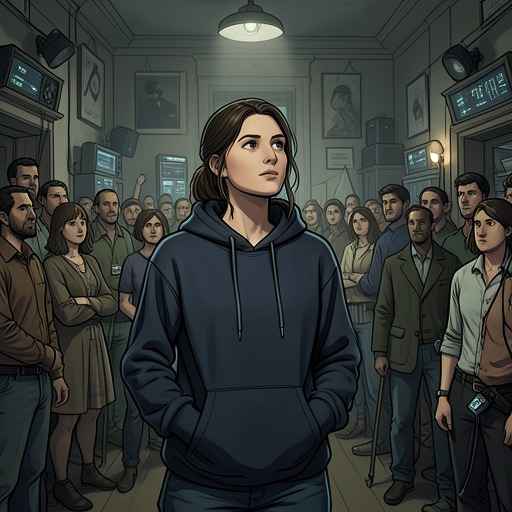
In The Ring, Brianna faces Milez and directs her battle verse not only at him but at the question of who wrote his rhymes. She calls out the possibility that he is a biter, invokes her father, and claims authority as a rapper from the Garden. The verse ends with her stopping mid-performance as the crowd responds enthusiastically. Her victory is therefore both a contest result and a public arrival: a young performer turns accusations about authenticity into the terms of her own attack.
The performance also links Brianna’s talent to her father Law’s reputation. An instigator later identifies her as Lawless’s daughter, invoking that inheritance as a provocation. At another encounter, Aunt Pooh answers a challenge about what Brianna’s words meant by insisting that Brianna does not claim any particular identity. The exchange underlines the difference between a performer’s language and the labels other people attach to it, even as Brianna’s family history makes those labels difficult to escape.
The success of “On the Come Up” enlarges that difference. A television report identifies the song with Bri and describes its violent character, its attacks on law enforcement, and its popularity with young listeners. The report presents the track as a public-safety concern, reducing a song and its young creator to a claim about influence. When Hype challenges the lyrics on air, he points to the talk of being armed and the implication that she would kill police. Brianna counters by asking whether the same material from her father at sixteen would have surprised him. Her objection is not that the lyrics have no force; it is that age and gender shape whose force is treated as alarming.
At the interview, Brianna says she is angry and responds to the criticism with a blunt dismissal. Hype interrupts her to frame the lyrics as excessive, while the conversation makes her status as a sixteen-year-old girl central to the dispute. The episode shows how a media setting can invite her to speak and then narrow what her speech is allowed to mean: the song becomes evidence against her, while her challenge to the framing is itself readily treated as attitude.
Business, Image, and Family History
Supreme tells Brianna that the public will continue to run with an image regardless of what she intended, and advises her to play whatever role is being imposed. His counsel identifies the performance trap at the center of her career: the image may be useful to the business, but other people can mistake the image for the person. The phrase is advice in a pragmatic register, not a solution to the distinction between a role she performs and an identity she accepts.
That pressure becomes explicit in the studio. Supreme points out that the man inside has substantial money available and insists that Brianna must record the song, presenting the session as a business opportunity from which they should take as much as possible. His reasoning places commercial gain ahead of her artistic choice. Brianna is being offered access and a possible step forward, but the price is to deliver material she has not chosen as her own.
Supreme’s account of Law complicates his authority to make that demand. He says Law was not a gangster when they met: he had been in a church choir and worked jobs to support Brianna’s mother and brother. Supreme claims that he encouraged Law to rap street material and associate with the Garden Disciples to seem authentic, and that Law took the role seriously. This recollection turns the image-versus-person conflict into family history. Brianna’s father, whose reputation can be used against her, was also shaped by a music-business strategy that blurred the line between manufactured image and lived identity.
The pattern surfaces in smaller public encounters as well. On a bus, someone calls out Brianna’s full name while admitting he does not know her middle name; James Irving describes her as embodying a sassy Black-girl image. These moments expose how casually others turn her into a recognizable type. Their familiarity does not amount to understanding: Brianna is made legible through a persona that other people can name, joke about, or sell before they know what she means to express.
Choosing Her Own Voice
The question of authorship becomes decisive when Brianna is expected to perform a new song. She says she had been meant to come up and do that song, but asks whether she may instead perform something from her heart. The choice directly rejects the assumption that an opportunity, a contract, or an audience entitles someone else to decide what she says.
Her freestyle refuses several roles at once: a source of amusement, a pet, a puppet, a clone, a sellout, and a thug. She describes herself through relationships—to her daughter’s and sister’s place in other people’s lives, and as somebody’s hope and mirror—rather than accepting the market’s or public’s single definition. She also connects the expectations placed on her to children in the Garden who are hungry, to hardened circumstances, and to an audience prepared to treat a racialized image of violence as the truth about a community. The verse insists that the argument is larger than rap: the problem is not only what Brianna performs, but who profits when performance is taken as a complete account of her and her neighbors.
After lowering the microphone, Brianna recalls imagining crowds chanting her name while she stood before mirrors with hairbrushes as a child. The crowd before her exceeds that childhood picture, but the decisive change is internal: she knows she is where she is supposed to be and doing what she was made to do, whether or not the audience responds. Her ending does not depend on public approval to certify her talent. It rests on the recognition that choosing what to say, rather than merely playing the role assigned to her, is part of what makes the performance hers.
Narrative Significance
Brianna’s story repeatedly sets performance against interpretation. In The Ring, she uses a persona to command a crowd; in the news report and radio interview, other people treat the persona as biographical fact; in the studio, commercial opportunity asks her to reproduce an image; and in her final performance, she makes authorship itself the subject. The contexts change, but the conflict remains: who gets to determine what her words mean and who she is.
The novel does not flatten that conflict into a choice between a false public self and a pure private self. Brianna wants to rap, takes pride in winning the battle, and understands the pull of money and recognition. Her refusal is narrower and more consequential: she will not let those ambitions require her to perform words that are not hers or accept the assumptions attached to them as truth. Her arc turns on that distinction, ending not with the disappearance of public judgment but with Brianna’s claim to speak for herself.